

Our Health Literacy Commitment
In the UK more than 4 in 10 adults find it difficult to understand health information written for the public.
Millions of adults read at, or below, the level of an average 9 year old. More than 6 in 10 adults struggle with health information that includes numbers and statistics, and up to 1 million people cannot speak English well, or at all.
Health literacy is about communicating health information in ways that people can understand.
We are committed to becoming a Health Literate Organisation. We believe this will help more patients, care-givers and members of the public to benefit from the work we do.
We will source and share training, support, and resources to enable us to be a Health Literate Organisation. We will consider the health literacy levels of the people who:
- we communicate with verbally
- access information we produce in all formats
- use the services we design, deliver, and improve
This should mean our communications get better and better. We will encourage those we work with to take a health literacy approach too.
Click on image to enlarge
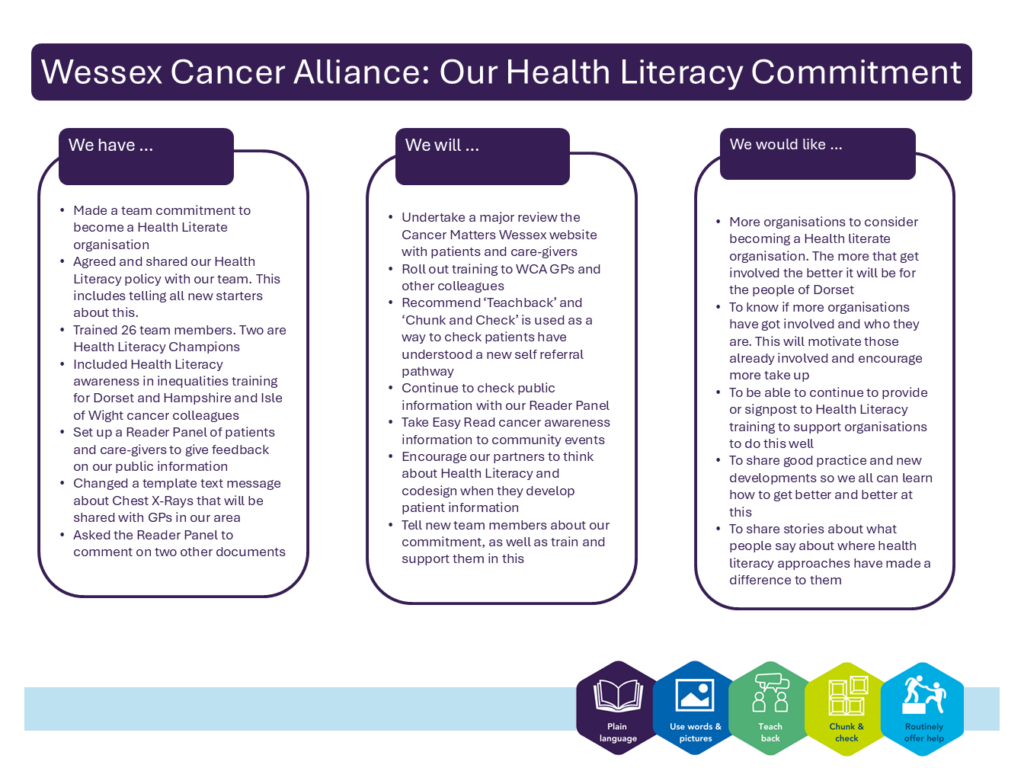
Read our Health Literacy Policy
Get Involved
We have set up a Reader Panel to ensure that new written information we produce uses health literacy good practice and has been user tested.
You can find out more about our Reader Panel, and other ways to get involved in our work, by clicking on the button below.
Resources
Our Health Inequalities and Patient Experience Network is for anyone who would like to get advice, guidance and support around health inequalities and patient experience in cancer care
NHS Readability Tool – others are available, including Hemingway
Health Education England’s Health Literacy How-to Guide
Patient Information Forum Health Literacy resources, including a checklist
NHS England has commissioned a health literacy geodata tool that provides a percentage estimate of low health literacy among local health authority populations