

What is Prehabilitation and Rehabilitation in Cancer?
Prehabilitation prepares people for their cancer treatment by optimising their physical and mental health through needs-based prescribing of exercise, nutrition, and psychological interventions. Prehabilitation is part of a continuum to rehabilitation.
Rehabilitation enables people to maximise the outcomes of their treatment and minimise the consequences of treatment such as fatigue, breathlessness, lymphedema, by supporting patients to address practical problems caused by disease and treatment.
Why is prehabilitation and rehabilitation important for people with cancer?
- Empowers people with cancer to enhance their mental and physical health
- Supports creating healthy behaviours
- Improvements in fitness and nutrition status
- Improvements in neuro-cognitive function
- Reduces length of stay in hospital
- Reduces post treatment complications
- Enhances quality of life
- Supports a personalised care approach


Wessex Prehabilitation and Rehabilitation in Cancer Conference 2025
Our Wessex Prehabilitation and Rehabilitation in Cancer Conference was held at the beginning of July, with resounding success, drawing a large and engaged audience of system leaders, Allied Health Professionals, Nurses, Medics and the Support Workforce from across the country.
The conference featured keynote addresses from Professor Peter Johnson, National Clinical Director for Cancer, NHS England and Professor Ramani Moonesinghe, National Clinical Director for Perioperative and Critical Care and Interim National Directory of Patient Safety, NHS England.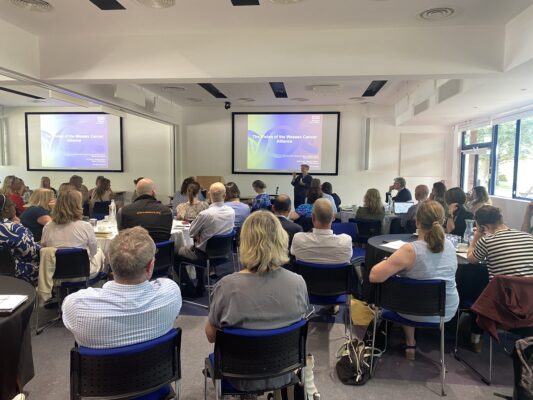
The event showcased the early findings in the updated Macmillan/NIHR/CPOC/RCOA/WCRF/Southampton BRC ‘Prehabilitation in people with cancer: Clinical and implementation guidance’, led by Professor Mike Grocott, Consultant intensivist, University Hospital Southampton NHS Foundation Trust and Director of the Southampton Biomedical Research Centre, University of Southampton and June Davis, Lead Allied Health professional and Nursing Adviser, Macmillan Cancer Support and AHP Consultant Advisor, Wessex Cancer Alliance.
The session emphasised the growing evidence behind multimodal prehabilitation strategies transforming cancer care and treatment using person-centred care models.
In the afternoon, we looked at local examples of delivery of Cancer Prehabilitation and Rehabilitation across the differing levels of intervention in multiple sectors. We were joined by colleagues from Hampshire Hospitals NHS FT, University Hospital Dorset NHS FT, Central Bournemouth PCN and Dorset Care Association.
Delegates also participated in round table discussions focussing on sustainability of services, workforce, Integrated Neighbourhoods, Frailty and Cancer and prehabilitation for non-surgical patients.
Feedback from one attendee:
“Very interesting learning about the new guidance and how that may inform our practice within our perioperative team. All the morning talks were inspiring and got me thinking about and understanding how everyone fits into the cancer care pathway. We are all working towards the same goals for our patients and should be working together a lot more.”
The conference reaffirmed the growing recognition of Cancer Prehabilitation and Rehabilitation as a vital component of personalised care and treatment. Plans for an expanded 2026 edition are already underway.
Wessex Cancer Alliance work
In 2022/23, we recognised the need to scope the prehabilitation and rehabilitation services that support children, teenagers and adults with cancer. Services were identified and evaluated using an online survey for service providers and commissioners. This was co-ordinated with desk-based research.
Summary of report findings
- Prehabilitation and rehabilitation support for patients is integral to personalised care and support for people with cancer.
- There is considerable current and rapidly emerging national and international evidence demonstrating the positive benefits of prehabilitation and rehabilitation to people with cancer, service provider organisations and commissioners.
- This scoping work has highlighted the different levels of understanding of what prehabilitation, and rehabilitation means to people with cancer, carers, professionals and commissioners.
- Prehabilitation and rehabilitation service provision is mixed and not equitable across Wessex. Universal interventions are appropriate for anyone with cancer. Targeted interventions are appropriate for people with cancer and at risk of late effects of disease or treatment or other long-term conditions.
- The majority of services are delivered in the hospital setting or outpatient clinics, with some in patients homes, hospices or leisure sector.
- Staff who reported delivering prehabilitation include dietitians, clinical nurse specialists and physiotherapists. Physiotherapists and occupational therapists followed by support workers are the predominant staff groups delivering rehabilitation.
You can read our report into the findings and recommendations:
Toolkit and Service Improvement Tool
We have developed an interactive toolkit and service improvement tool. This is aligned with ongoing work across the UK into prehabilitation and rehabilitation in cancer, in particular the planned update of the NHS England prehabilitation guidance (2019) to promote equality and reduce health inequalities.
The aims of the toolkit and service improvement tool are to:
- Support the improvement of care and services for people with cancer
- Encourage a standardised approach to screening, assessment, and delivery of interventions at the Universal, Targeted and Specialist level in accordance with a personalised care approach
- Enable services to identify areas that are working well and/or challenges faced, and opportunities for improvement
- Promote continuous improvement of services with a suggested opportunity to review services every 12 months using the tool
- Support health and care staff across all sectors who are designing, developing or delivering prehabilitation and rehabilitation for people with cancer

PACED approach
A set of five key principles have been developed that underpin what good looks like in prehabilitation and rehabilitation:
Value 1: Person-focused (in planning, prioritisation and goal setting, decision making and delivery of care)
Value 2: Accessible and timely
Value 3: Co-ordinated (by a care MDT) in partnership with the person
Value 4: Experience of care is optimal
Value 5: Delivered with skill and competence