
Project Overview
The initial aim of this project was to work collaboratively with specialist teams, from areas within cancer care, to develop academic modules for nurses. This would involve using the specialist teams’ in-depth knowledge about their area of cancer care.
The challenge was to produce a number of modules that would recognise the skills required and meet the specific learning needs of the clinical nurse specialists working in cancer care. The modules needed to deliver high quality information in a format that was clear and educational, that would inspire the workforce to work at a high level and maintain professional standards.
The knowledge gained from the courses could ultimately be used to deliver high quality holistic care that will improve the patients’ experience.
For more details about this project, please watch our short video.

This image represents how the modules could be assembled into an academic pathway – developed with the University of Southampton (UoS) – for nurses working in cancer care.
This pathway could be used to study stand-alone modules, or combine them to complete a Post-Graduate Certificate, a Post-Graduate Diploma or a Masters in Professional Practice in Health Sciences.
Click here for further details about the Professional Practice in Health Sciences academic pathway

Click image to enlarge
Training Modules and Pathway
Funding was secured by WCA from Health Education England (NHS England) to support the development of Cancer care Clinical Nurse Specialists across Wessex.
The modules and pathway were promoted across the region with a cohort of CNSs recruited – cohort 1 – to start the pathway in September 2022. The students studied three modules – Personalised Care, Research Methods and Psychological Support Skills in Cancer Care – to complete the first part of the pathway and gain a Post Graduate Certificate in Professional Practice in Health Sciences.
Cohort 2 began the first part of the pathway in September 2023. The order of the modules was adjusted to reflect the student feedback and to accommodate the UoS academic calendar.

More details about the modules can be found below:
This module is a core requirement for the academic pathway and was taught using an existing UoS course. Details of this module can be found here:
Student feedback from cohort 1 (January 2023, on-line delivery) and cohort 2 (September 2023: in-person delivery)
“Made me more aware of how trials are carried out.”
“Helped with academic work moving forward.”
“Gained more knowledge about research in general.”
“I am more confident to search literature and use evidence-based practice in my role.”
“Helped with the process of searching for literature and critiquing it.”
“Research module allows me to conduct database search and critically analyse papers relevant to my area of interest.”
“I am much more confident at being able to find reliable evidence. I enjoyed the module and gained a lot from it.”
“Review viable research studies, helping to guide changes to local services in the future.”
“I think if you are planning to do the masters module it is good to start with Research methods, it lays the grounds of studying at masters’ level. I learned about studying at SOUTHAMPTON UNI, using the library resources, and how to critically appraise different types of articles.”
“Although I was initially reluctant, and I did find this module tough, I have learned from it. I am finding myself using the knowledge to support with my further studies, and to use evidence to look at the best ways of working and the outcomes of treatments. I have used the knowledge from my assignment to give patients evidence to support them with decision making about treatment options, which I found difficult to put into words before.”
This module was developed by a team of experts from Wessex Cancer Alliance in partnership with the University of Southampton (UoS). The module was developed using the same strategy that was utilised in the development of the personalised care module.
The specialist steering group included experts in psychological support skills from Wessex Cancer Alliance and UoS. The steering group worked as a team to develop the module and structured it around 4 themes:
1. Reflective and reflexive practice
2. Detection, screening, and assessment of need for psychological support
3. Formulation and intervention
4. Referring onwards
The content included an education package devised by SWAG (Somerset, Wiltshire, Avon and Gloucestershire) Cancer Alliance, to deliver level 2 psychological support skills.
The management of the module was taken on by UoS and it was delivered to the students in the summer of 2023. More details about the module can be found here:
Psychological Skills in Cancer Care – University of Southampton
Student feedback from cohort 1 (April 2023) cohort 2 (January 2024):
“Really enjoyed it.”
“Enjoyed the module and learning.”
“No comments – it was fab!”
“Really a very good module. Very relevant to my job.”
“Very interesting and worthwhile module.”
“Well taught and I really enjoyed the sessions.”
“Great teachers and taught sessions.”
“Very well run and excellent speakers.”
“I will use the different techniques taught in practice.”
“The speakers and Lyn Calman were superb. My favourite course so far.”
“Brilliant speakers; brilliant lead tutor; really good communication of what was expected and support.”
“Psychological skills for all HCP is important to better understand our patients and have meaningful conversation with them. This is a fundamental skill that is enhanced by doing the module.”
“I think that it was one of the most useful training opportunities that I have had. We learned so much from each other, but also from how we can continue to improve to support the patients, and how valuable we are.”
2022 Module
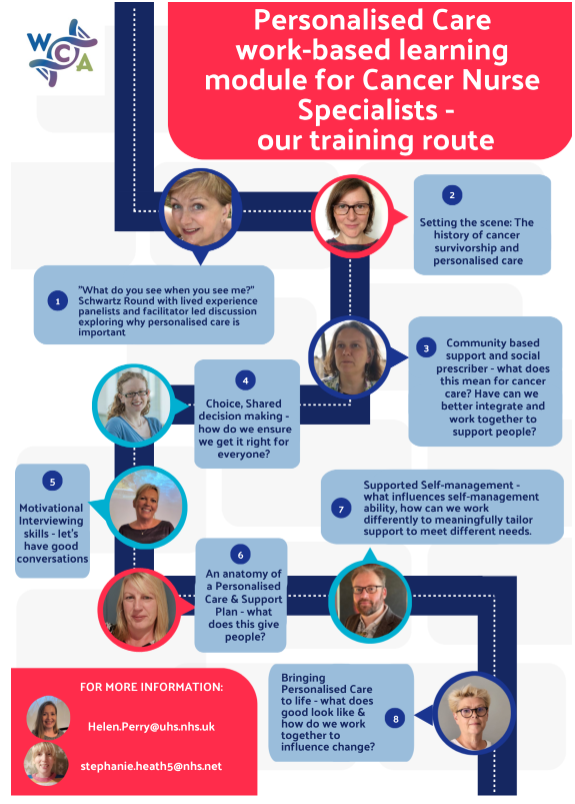
The module was created using the University of Southampton (UoS) work-based learning module framework which allows the personalisation of the contents of the module, in order to meet the specific learning needs of the group of students.
This module was developed by creating a steering group of experts in Personalised Care from WCA and UoS. They worked together as a team to create the contents and format of the module with many individuals involved in the delivery of the taught content.
The module was structured around the 6 domains of personalised care:
- shared decision making
- supported self-management
- personalised care & support planning
- social prescribing
- patient choice
- personal health budgets.
The module also included taught sessions on self-awareness, values based commissioning and motivational interviewing. A workbook was developed to complement the taught content and to allow the students to reflect on their own clinical practice. The completed workbook was submitted as part of the assessment, alongside an academic essay.
2024 Module
The steering group was reformed, and the module structure and content were reviewed based on student feedback following the 2022 delivery of the module. Slight adjustments were made to the content, with a 2-day Health Coaching workshop replacing the Motivational Interviewing day. It was felt that health coaching complemented and enhanced the module content. The module remained structured around the 6 domains of personalised care. The workbook was reviewed and streamlined. The written assessment was replaced with a 20-minute presentation which the students would deliver to an invited audience.
Student feedback from cohort 1 (September 2022) and cohort 2 (May 2024):
“Good speakers and variety of topics.”
“The module was engaging and interesting.”
“Well led and good to meet colleagues form other Trusts.”
“I enjoyed the interaction with colleagues from other trusts.”
“The module has been informative, in a way that is easy to understand.”
“I developed some friendships which I have maintained and have a supportive group.”
“It has been interesting and useful for practice.”
“Good variety of speakers. Good to hear patients’ point of view and relate theory to practice. Learning from others within the group. Identified common barriers, restrictions in practice (space, workforce).”
“It was the first module that I studied, and it was so interesting and rewarding to be attending education which was really relevant to my job. I have also benefitted from meeting such a range of professionals from so many other Trusts and the access to the individuals who came and taught on the course was inspiring.”
Cohort 1 began the second part of the pathway in September 2023, leading to a Post Graduate Diploma.

More details about these modules can be found below:
This will be taught using an existing UoS module – details can be found here:
Student feedback from cohort 1 (September 2023) and stand-alone module students:
“I enjoyed the group work.”
“Helpful theory of leadership.”
“Helps me on how I deal and interact with staff.”
This module was developed as a collaborative project between WCA and UoS with a steering group of experts in cancer care formulating the course content and structure. It follows the patient pathway from detection to diagnosis and treatments, looking at advances and innovations in these areas and examining what cancer means on an individual and also on a societal basis.
The management of the module was taken on by UoS and it was delivered to the students in the spring of 2024.
Student feedback from cohort 1 (January 2024) and stand-alone module students:
“Very comprehensive.”
“Great teaching sessions.”
“Felt well supported throughout the module.”
“Really enjoyed the module and contents – less nursing focussed.”
“Excellent quality of teaching and well thought through.”
“Really, really interesting. I learned so much. It felt like every hour session could have filled a whole day.”
“Most talks were extremely informative and definitely relevant to our practice.”
This module has been developed by experts from WCA with academic support from UoS. The module follows a work-based learning format.
The module explores what effective communication is, why it is so important and what impact poor communication has. It revises communication theory, and examines sympathy, empathy, and compassion. Experts from UoS and WCA deliver sessions on “tender conversations” – having spiritual conversations with a person diagnosed with cancer, discussing prognosis, and dying and having conversations regarding sex and intimacy. The module goes on to explore self-awareness and supporting people with learning disabilities. It looks at strategies for challenging scenarios and also breaking bad news and examines anger, denial and collusion. There are opportunities to practice communication skills in simulated situations.
The module is assessed by a 20-minute simulated conversation with 5 minutes for discussion and reflection and a 2,000-word reflective critique of the conversation.
Please apply via the work-based learning module application.
Student feedback from cohort 1 (April 2024) and stand-alone module students:
“A good challenging course.”
“Highly recommended. Actors were spot on.”
“Very good tutor and great speakers.”
“Again, good speakers and taught sessions.”
“Really tough, but an opportunity to watch colleagues and also to challenge myself. It also helped me to think about more positive feedback and support about our everyday conversations which can be so difficult and important.”
Application process and contact details
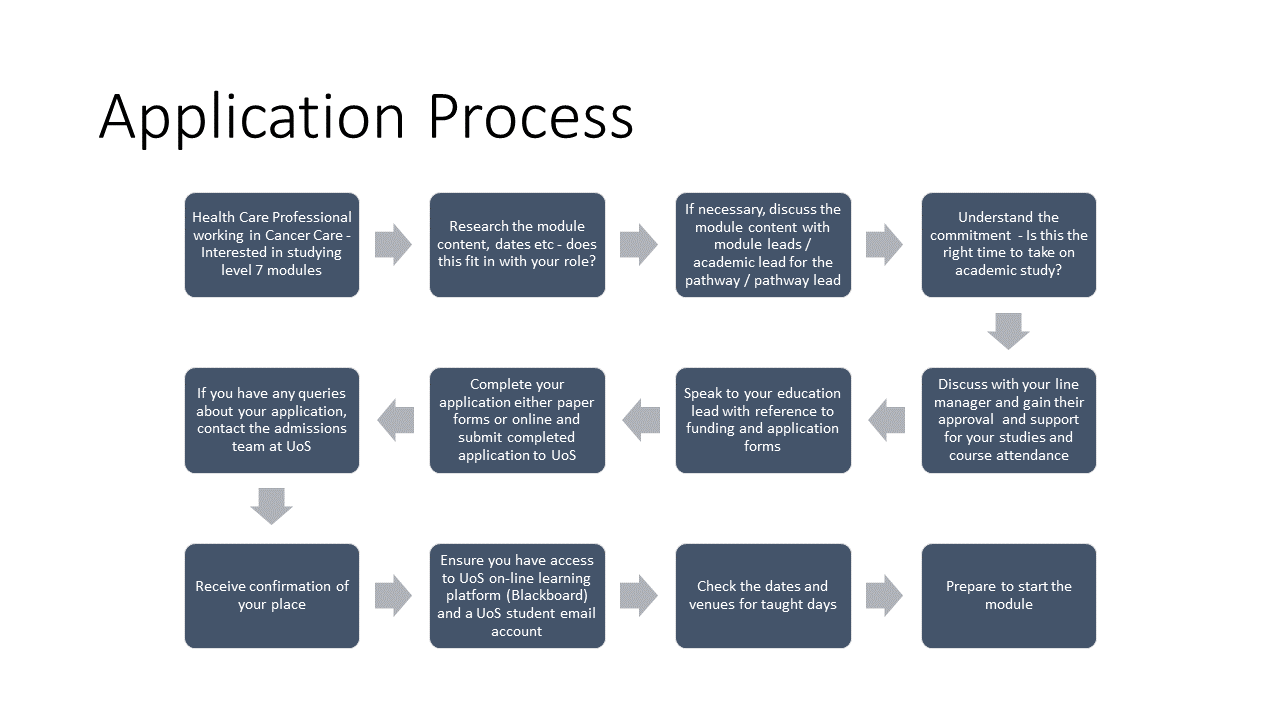
If you are interested in studying any of the modules or the pathway, please discuss this with your line manager and your education lead.
Click image to enlarge.

For general information about the modules, please contact Lynn Calman: L.Calman@soton.ac.uk

For information about the academic pathway, please contact Chris Franks: C.J.Franks@soton.ac.uk
For specific details about the modules, please contact the module lead – details can be found via the UoS website: Professional Modules | Health Sciences | University of Southampton
For enquiries about the application process, please speak to your education lead, or the admissions team at UoS if you have any specific queries about your application.
For more details about the project, please contact Helen Perry: helen.perry@wca.uhs.nhs.uk or Kathy Cooke: Kathy.cooke@wca.uhs.nhs.uk
Project Milestones
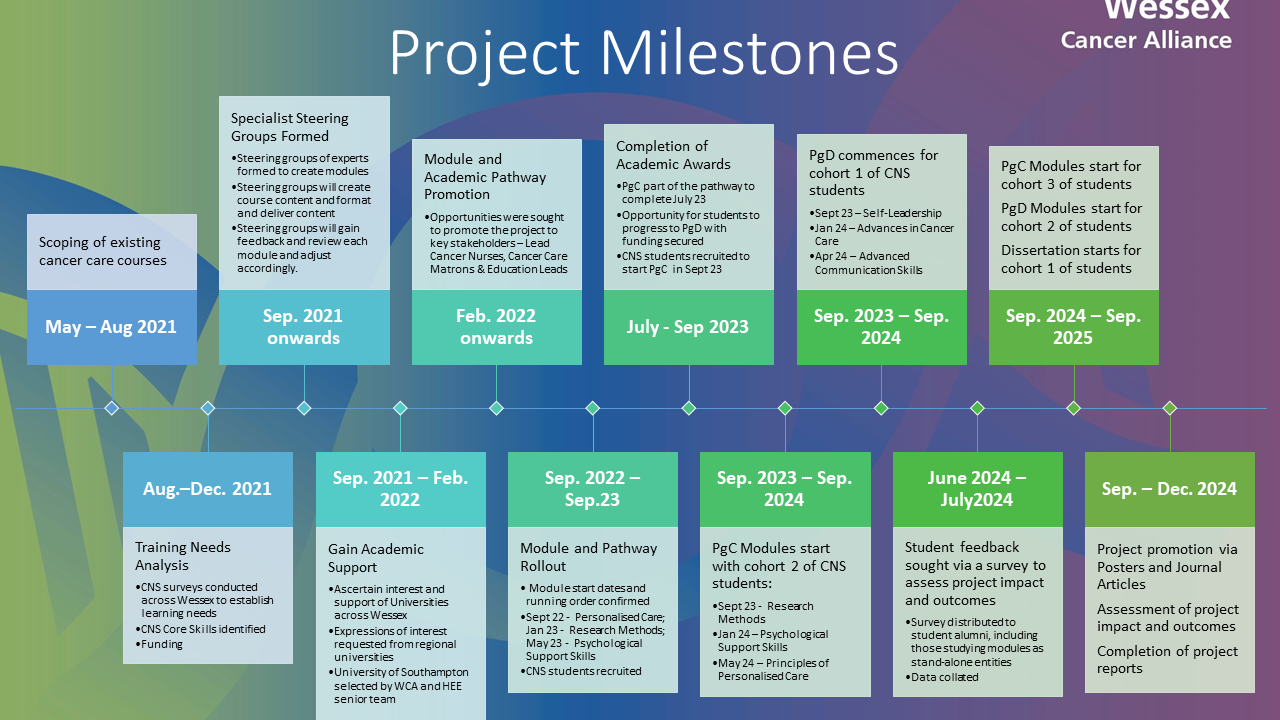
The following image summarises the key milestones for this project to date: