
Since we introduced our Communications and Patient, Care-giver and Public Involvement Strategy in 2020, people have been increasingly involved in our work, and we have strengthened our communications with our partners, patients and the public. We have established a culture that understands the importance of effective communications and meaningful patient, care-giver and public involvement (PPI). As a result, people are much better informed about our activities, as well as involved in shaping and influencing them.
On this page you can find out more about what we have done as a result of patient and public involvement. There are links to read case studies, our latest impact report and examples of recent Steering Group activity.
For information about current projects you can help with, click on the link below:
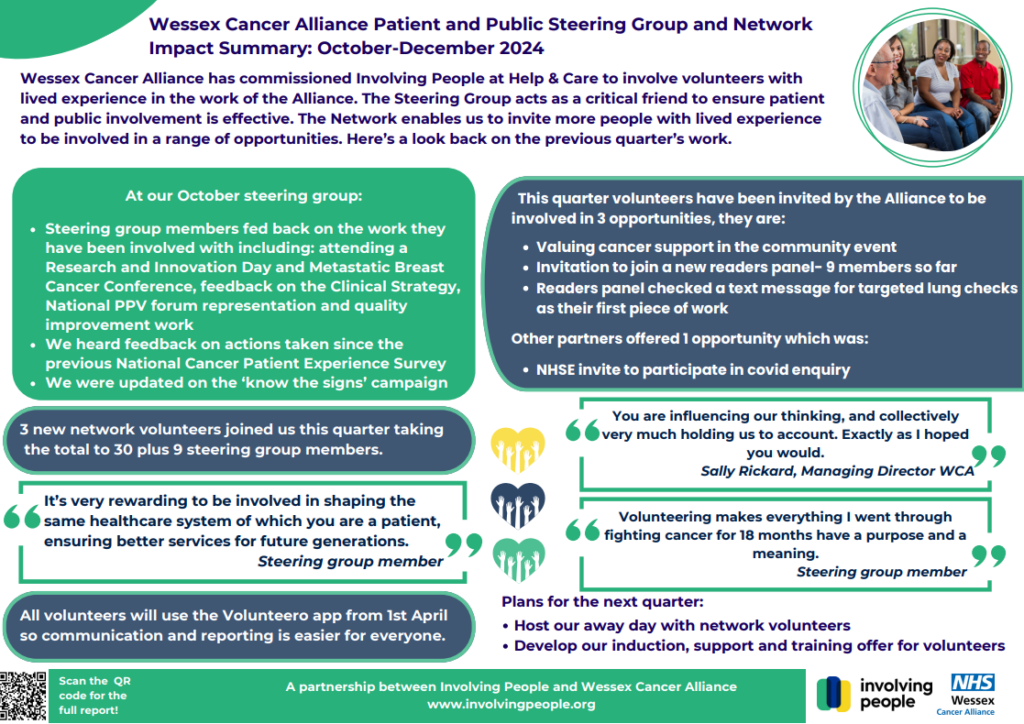
Impact Report – December 2024
Click on image to enlarge
Case Studies
Click on the links below to read examples of how public and patient involvement has made an impact on cancer services in Wessex.
Recent Steering Group involvement
Our Steering Group always provide an invaluable contribution in the different ways they get involved. Read about some recent activities:
Our Patient and Public Involvement Steering Group meet regularly and make sure we take patients views into account in everything we do. We also have a Network of people who we can consult with, invite to events and ask to comment on literature etc.
At least once a year we bring everyone together face to face, so we can talk in person (rather than online) and discuss how to support our Network members, as well as Alliance plans and issues that are important at the time. We got 2025 off to a great start by holding our Awayday in January.
Here is what one of our Steering Group members said about what the day covered day and what they got out of it.
“I was keen to attend this event as it was a good opportunity to see everyone face to face and for me to meet some of the group for the first time.
I was curious to understand more about the Alliance and learn more about their hopes for the future. It was good to hear how they had responded to prior patient and public feedback and suggestions. This set the scene using plain language and also explained the context and background of their ambitious five – year plan. It was positive to see the aspirations but also important to understand some of the constraints and challenges.
The discussion sessions during the remainder of the day were useful for information or development and support of the volunteers working with WCA.
We were encouraged to ask questions throughout the day and had an opportunity to help shape the future of the Cancer Matters Wessex website. Some useful feedback and suggestions were given from the perspective of patients using the site.”
The Steering Group were the first people our Managing Director had a conversation with, about the new Wessex Clinical Strategy. The aim was to make sure their views and suggestions were the first to go into the make-up of this document, so that the patient voice was central to all other considerations. Since then, their continued input has helped shape the thinking of this strategy, as reflected by Matt Hayes, our Medical Director:
“I always value the perspective of the Steering Group members on the evolution of our strategy and work programme, and hope that members feel that this is recognised. My recent presentation of our proposed Wessex strategic cancer plan seemed well received and I heard some very valuable feedback and opinion. In particular, the need to provide better communication and co-ordination, the need for greater personalisation of care, and the reality that treatment pathways contain increasing numbers of patients on long term anti-cancer therapy (sometimes for years and decades) was well made. I am very grateful for the invitation to present to the group, and look forward to working together to deliver our plans.”
Eileen and Sarah have been involved in the planning and delivery of the patient participation aspect of the Quality Improvement training for Cancer Nurse Specialists and Cancer Support Workers. Their contributions mean the programme is more focussed on patient participation and how professionals can think about involving people at an earlier stage in their projects.
“We have seen some brilliant projects being developed. Before the course, some colleagues hadn’t even thought about involving people in the services they are developing. Now they are, with our support to build their confidence to do this.” Eileen Stonock, Steering Group Chair
“We are now keen to see them gather some data about how patient involvement has been effective.” Sarah Rowcliffe, Steering Group member
Five patients and care-givers from our Steering Group and the Southampton University Clinical Trails Unit, took part in a recent event highlighting the difference that research and innovations is making and to discuss how the Alliance can make this more accessible to patients living in Dorset, Hampshire and Isle of Wight.
“Research relies on people and the big question is how you get people involved when they are potentially at their most vulnerable.”
They found it interesting and thought provoking to learn about new developments in cancer detection and treatments. They were particularly impressed with the difference that focussing on areas of deprivation is having on the early detection of lung cancer, through Targeted Lung Health Checks, in communities who are usually less likely to take up cancer screening programmes
Event organiser, Anna Wykes said: “It’s always incredibly valuable to have patients working with clinicians to discuss how we move forward, especially how we make clinical trials more inclusive. We are now working with colleagues from research to use the suggestions and conversations captured from the event to inform how we begin to do this. We will be sharing news about this as plans develop and intend to continue to involve patients and members of the public as we go.”
Carla recently attended the second patient-led Metastatic Breast Cancer (MBC) conference in Manchester. Organised by Greater Manchester Cancer Academy in collaboration with METUP UK, the aim of the conference was to improve services for MBC patients.
During the event, they shared and discussed developments in:
- early detection
- access to clinical trials
- new and better treatments
- support available to patients through new roles that will bridge the gap between primary and secondary care
Carla said, “A very informative, worthwhile conference. I felt excited to hear about the development of new drugs, frustrated over the absence of a centralised clinical trial database, and hopeful to hear about the positive difference the new roles could make to those getting a diagnosis now.”
Geoffrey has recently signed up to be a Patient Voice Representative in the NHS England National Cancer Programme. This is an opportunity to influence national priorities around cancer and at his first meeting there was discussion about the national cancer waiting times and faster diagnosis screening and tests. Next time it will be about living with and beyond cancer.
“At the first meeting there was a huge amount of information and ‘NHS speak’ to get my head around so I am going to try and influence how the national team do things so it can be more inclusive from patients’ perspectives. I am looking forward to the challenge.” Geoffrey Smail, Steering Group member.