careers in cancer

Is Physics your favourite science subject? Are you a critical thinker?

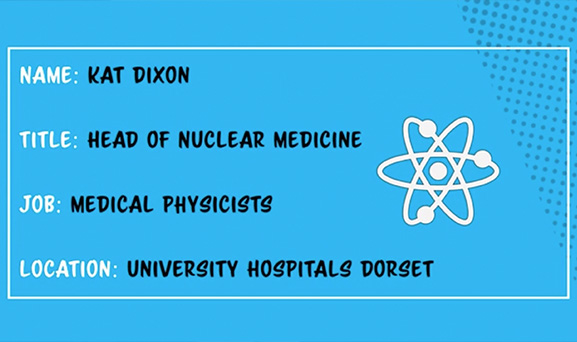
A Medical Physicist is a type of clinical scientist that use radioactive traces to identify, treat or cure cancer. 
As a Medical Physicist, you are likely to: 
  • work clinically as part of a multi-disciplinary team in a hospital 
  • diagnose and/or treat patients with cancer
  • plan treatment programmes and explain procedures to patient
  • use computer simulations and mathematically modelling in research and development
  • monitor equipment to make sure it’s accurate, safe and well-maintained
  • write reports and present to scientific and non scientific audiences
  • perform some teaching or lecturing 

Entry Requirements

You will need to achieve:
5 GCSEs at grades 9 to 4 (A* to C), or equivalent, including English, maths and science and
2 or 3 A levels, or equivalent, including Maths and Physics

Training Routes

You will need to complete an undergraduate degree with a focus on physics such as applied physics, physics and mathematics or astrophysics. You would then apply to complete the NHS Scientist Training Programme, a three-year, full-time, work-based learning and training programme that also includes academic study at Masters level.

You may be able to train for this job by doing a Level 6 Healthcare Science Practitioner degree apprenticeship.
An alternative route would be starting as a healthcare science assistant or associate and with experience move on to the degree apprenticeship.

Key Skills

You should have a keen interest and good knowledge of science, particularly Physics and Maths

The ability to think analytically and solve complex problems

Be able to work as part of a team

Be good at writing and communicating in different ways

Career Development

There is a clear pathway for healthcare scientists within the NHS, you could have the opportunity to grow and progress up to consultant level or head of department.

You could go on to lead a department, work in higher education, research, or in the medical equipment manufacturing industry.

Pay and benefits

A trainee medical physicist would likely start on a Band 6 in the Agenda for Change scale, progressing to a Band 7 once registered.

FURTHER INFORMATION

NHS England Scientist Training Programme

You could join the Institute of Physics and Engineering in Medicine
for professional development, training opportunities and to make industry contacts.

Accessibility Toolbar