
careers in cancer

Are you a great communicator AND a great problem solver?

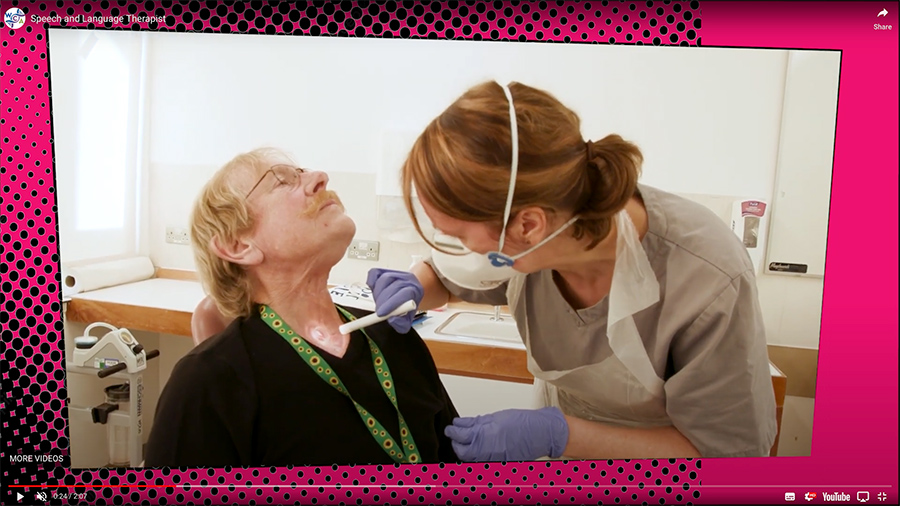
Speech and Language Therapists provide treatment and support for children and adults who have difficulties with communication, eating or swallowing. You may work in hospital, in the community or in people’s homes. In cancer care, speech and language therapy is primarily focused on supporting patients with head and neck cancer which can impact on both communication and swallowing.

As a speech and language therapist in cancer care, you are most likely to:

  • work in a hospital setting
  • work alongside a range of disciplines including doctors, nurses and dentists
  • run clinics over the phone and in person
  • visit patients on the ward who need support with speech or swallowing
  • support patients who have had a laryngectomy (removal of the larynx) in the hospital and at home 
  • help patients with speech or swallowing problems before, during and after cancer treatment
  • work with patients during diagnosis, through their treatment and after treatment
Entry Requirements

You will need five GCSEs (five A-C/9-4 grade GCSE’s) including English Language, Maths and Science

Plus two or three A-Levels or equivalent such as an Access to Health Professionals course

To access an undergraduate degree in speech and language therapy

Training Routes

  • You can complete a 3 or 4 year undergraduate degree accredited by the Royal College of Speech and Language Therapists (RCSLT)
  • If you hold a relevant first degree you can apply for an accelerated postgraduate programme in speech and language therapy which normally takes two years.
  • A degree apprenticeship for speech and language therapy has also been approved

In Wessex you can access the accelerated postgraduate programme at the AECC University College in Bournemouth

An alternative career would be to work as a Speech and Language Therapy (SLT) Assistant or Support Worker if you did not want to study at university.

Key Skills

You will be:

  • a great communicator
  • happy working in a team
  • able to support patients
  • able to put people at ease
  • organised
  • adaptable and flexible
  • a problem solver

Career Development

After qualification you can chose to specialise in a particular area such as cancer care.

You could go on to do further training in enhanced and advanced clinical practice or progress into a clinical team lead role, operational management, or head of speech and language therapy role.

You could also move into teaching or research.

Pay and benefits

As an speech and language therapist, you’ll be paid on the Agenda for Change (AFC) pay system, typically starting on Band 5.

Speech and Language Therapist

Accessibility Toolbar